Waiting in an outpatient service can reflect different problems. One patient moves between departments; another joins a queue concentrated in the early morning. Total attendance alone may not reveal the distinction. Two recent Chinese hospital accounts illustrate separate approaches to coordination and capacity.
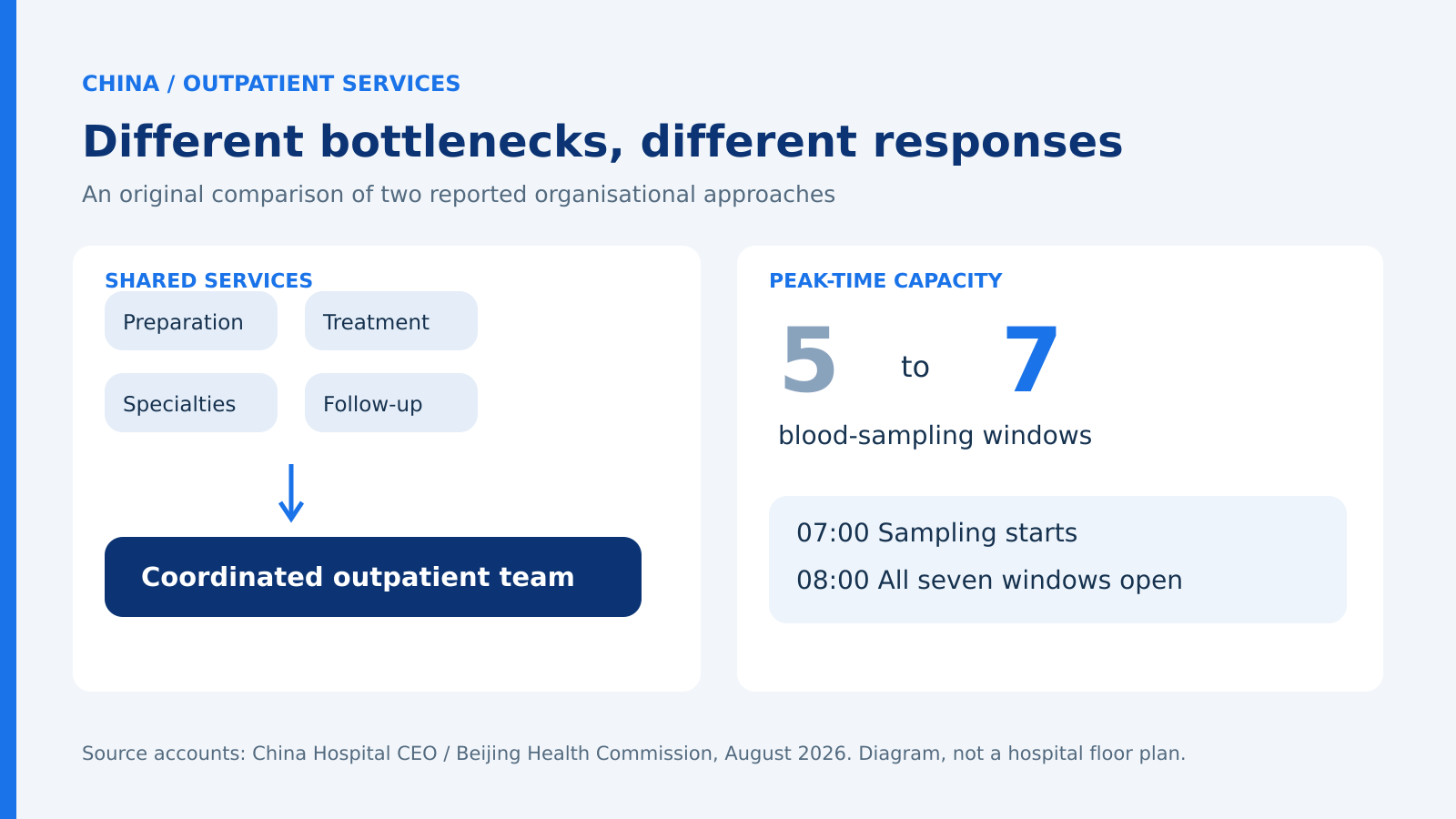
An 8 August report in China Hospital CEO describes West China Second University Hospital bringing more than 100 treatment and investigation services from over ten departments under an outpatient treatment unit. Treatment nurses and specialist nurses work within the arrangement. The account concerns shared resources and the coordination of appointments, preparation and care across departments. It is based on interviews and the hospital’s experience, rather than an independent evaluation of effectiveness.
A Beijing health authority account addresses a narrower pressure at a children’s medical institution. In June, blood-sampling windows increased from five to seven, with service beginning at 07:00 and all windows open by 08:00. Staffing was adjusted around demand. This changes the capacity of a particular stage at busy times rather than reorganising an entire pathway.
Reading the accounts together suggests a useful distinction. Additional windows may not resolve a problem caused by handovers between departments. Equally, a shared service platform does not remove the need to match staffing to concentrated demand. This is an interpretation of the contrasting designs, not a trial comparing their effectiveness.
Payment policy adds a separate context. An NHSA explanation published on 19 August discusses exploring outpatient payment pilots that link capitation in primary care with chronic disease management. That focus should not be treated as an explanation of results in the two hospital accounts.
The examples describe what changed more clearly than how much benefit followed. The Beijing account does not provide comparable waiting-time measurements before and after the change, while the West China report relies principally on institutional experience. Evaluation should consider the whole patient journey alongside staff workload, handovers and safety, so that improvement at one point is not mistaken for improvement across the service.
The original cover is a process illustration, not a hospital floor plan.
References